FZ-QSAR — Predictive Modeling of Antibiotic Properties
Overview
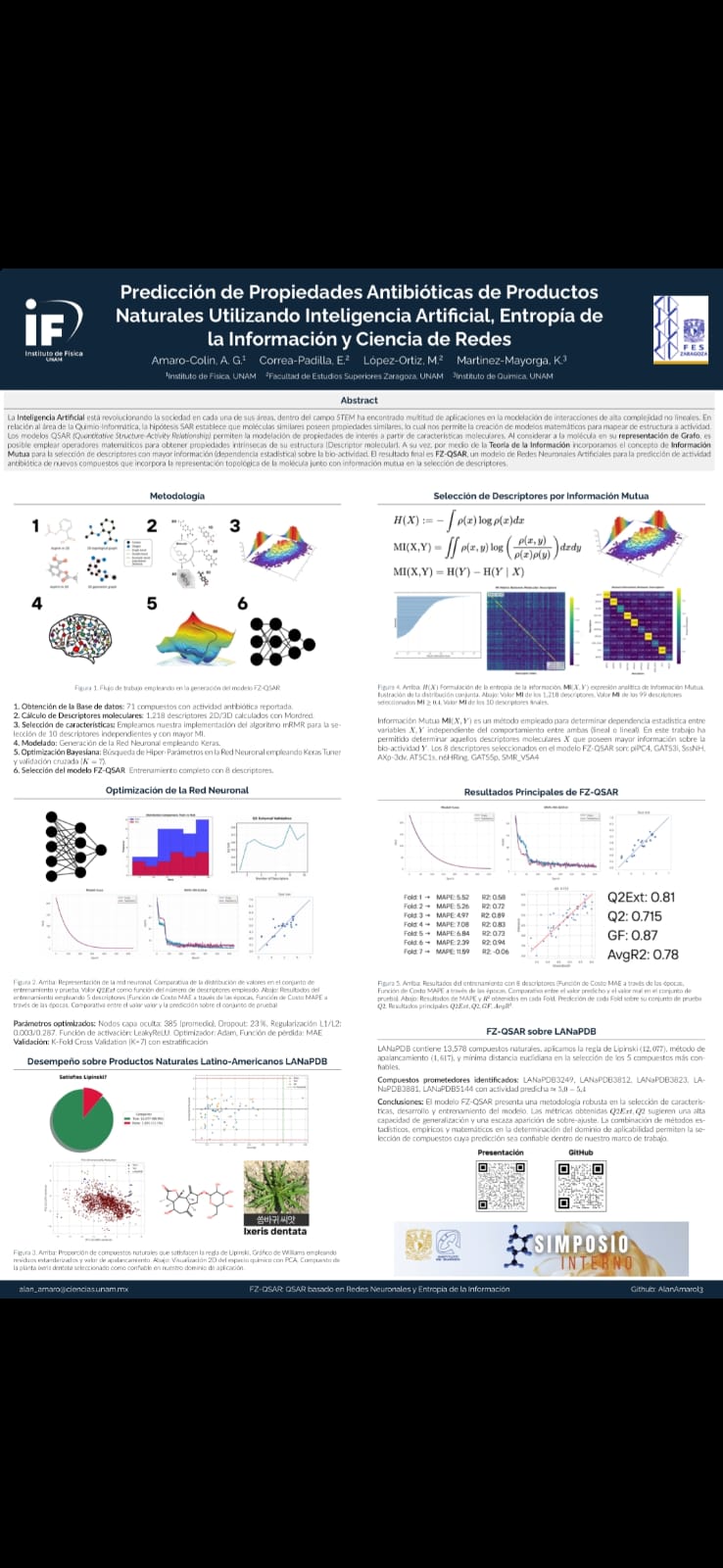
Artificial Intelligence is transforming every area of society, and within STEM it has found numerous applications in modeling highly complex non-linear interactions. In the field of Cheminformatics, the Structure-Activity Relationship (SAR) hypothesis states that similar molecules possess similar properties, enabling the creation of mathematical models to map from molecular structure to biological activity.
QSAR (Quantitative Structure-Activity Relationship) models allow the prediction of properties of interest from molecular features. By representing a molecule as a graph, it is possible to employ mathematical operators to obtain intrinsic structural properties — known as molecular descriptors. Through Information Theory, we introduce Mutual Information to select the descriptors with the greatest statistical dependence on bioactivity. The result is FZ-QSAR, an Artificial Neural Network model for predicting antibiotic activity of novel compounds that integrates the topological representation of molecules with Mutual Information-based descriptor selection.
The model was applied to screen the LANaPDB (Latin American Natural Products Database), containing 13,578 natural compounds. After applying Lipinski's Rule of Five, leverage analysis, and minimum Euclidean distance criteria within the applicability domain, five highly promising antibiotic candidates were identified.
Methodology & Architecture
Data & Molecular Descriptors
A curated dataset of 71 compounds with experimentally reported antibiotic activity was compiled. For each molecule, 1,218 molecular descriptors (2D and 3D) were calculated using Mordred, a high-performance molecular descriptor calculator. These descriptors encode diverse structural and physicochemical properties including atom counts, topological indices, electrostatic properties, and 3D geometric features.
Feature Selection via Mutual Information
Mutual Information MI(X, Y) is a method for determining statistical dependence between variables X and Y,
independent of the nature of their relationship (linear or non-linear). In this work, Mutual Information enabled the
identification of molecular descriptors X that carry the most information about antibiotic bioactivity Y.
Our custom implementation of the mRMR (minimum Redundancy — Maximum Relevance) algorithm was applied to select an optimal, non-redundant subset of descriptors. From the initial 1,218 descriptors, 99 were retained with MI ≥ 0.4, and the mRMR procedure further distilled these to 10 independent descriptors, out of which 8 were selected for the final model:
piPC4 · GATS3i · SssNH · AXp-3dv · ATSC1s · n6HRing · GATS5p · SMR_VSA4
Model Architecture & Hyperparameter Optimization
The predictive model was built using Deep Neural Networks with Keras 3. Hyperparameters were optimized through Bayesian Optimization using Keras Tuner with K-Fold Cross-Validation (K = 7) employing stratified folds to ensure representative activity distribution across all splits.
The optimized architecture used the following configuration:
- Hidden Layer Nodes: 385 (average across folds)
- Activation Function: LeakyReLU
- Dropout Rate: 23%
- Regularization: L1 = 0.003 / L2 = 0.287
- Optimizer: Adam
- Loss Function: MAE (Mean Absolute Error)
Applicability Domain & LANaPDB Virtual Screening
To ensure reliable predictions, a rigorous applicability domain was established. The LANaPDB database of 13,578 Latin American natural products was first filtered by Lipinski's Rule of Five, retaining 12,077 drug-like compounds. A Williams plot (standardized residuals vs. leverage values) was then used to identify compounds within the model's structural domain. Finally, minimum Euclidean distance in the chemical space was applied to select the 5 most confident candidates within the applicability domain.
Promising compounds identified: LANaPDB3249, LANaPDB3812, LANaPDB3823, LANaPDB3881, and LANaPDB5144 with predicted antibiotic activity in the range of ≈ 5.0–5.4.
Key Achievements
- Developed FZ-QSAR, a robust QSAR framework combining Mutual Information from Information Theory with Deep Neural Networks for antibiotic activity prediction.
- Implemented a custom mRMR (minimum Redundancy — Maximum Relevance) algorithm for feature selection, reducing 1,218 Mordred descriptors to an optimal, non-redundant set of 8.
- Optimized the neural network using Keras Tuner with Bayesian optimization and K-Fold Cross-Validation (K = 7) with stratification, achieving an Avg R² of 0.81.
- Established a rigorous applicability domain using Lipinski's Rule, Williams plot (leverage analysis), and minimum Euclidean distance for reliable virtual screening.
- Screened the LANaPDB database (13,578 natural compounds) and identified 5 highly promising antibiotic candidates (LANaPDB3249, LANaPDB3812, LANaPDB3823, LANaPDB3881, LANaPDB5144) with predicted activity ≈ 5.0–5.4.
- Achieved strong generalization metrics — Q²Ext, Q², GF, and Avg R² — indicating high predictive capacity with minimal overfitting.
- Successfully presented findings at the internal research symposium of the Institute of Chemistry.
- Prepared a manuscript detailing methodology and results, in final stages of preparation for submission to arXiv.
Resources
FZ-QSAR on GitHub
Source code repository with the full implementation of the FZ-QSAR pipeline, including Mordred descriptor calculation, mRMR feature selection, and Keras-based neural network training with Bayesian optimization.
View Repository →Preprint (arXiv)
Full manuscript detailing the FZ-QSAR methodology, Mutual Information-based feature selection, model architecture, and LANaPDB virtual screening results — in final stages of preparation.
Coming Soon →Gallery